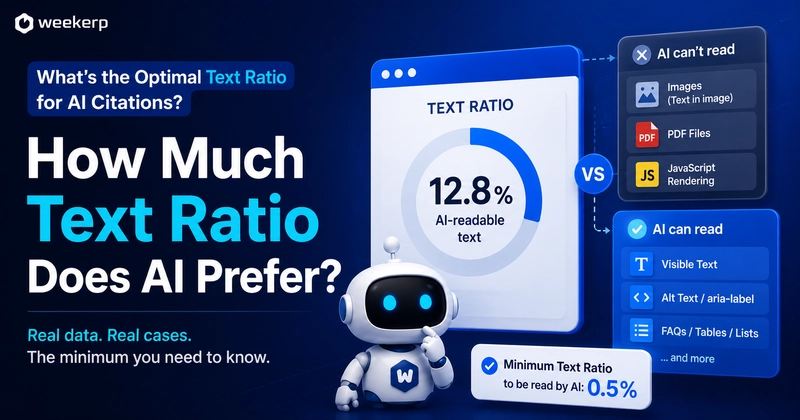
What's the right text ratio for a page AI will cite?
What's the right text ratio for a page that AI will cite?
A client recently asked me this:
"Can AI read our PDFs? We keep a lot of our information in PDFs — what do we do?"
"I heard you need a lot of text. But our page is basically all images right now."
Both were really asking the same thing: My information lives outside the HTML — is that a problem for GEO?
So we at Weekerp actually went and checked.
In this article, we look at the text ratio of pages that get cited well, ask whether text ratio really matters, and work out the minimum text ratio you need.
What is text ratio?
In this article, "text ratio" means the following:
Of all the HTML that makes up a web page, the share that is text AI can actually read.
Text ratio = readable text ÷ total HTML
Generally, "readable text" includes:
-
The headings and body text a user sees on screen
-
Product names, prices, and feature or service descriptions
-
An image's
altattribute -
A button or link's
aria-label -
FAQ questions and answers
-
Descriptions inside tables, lists, and tabs
-
Structured data
On the other hand, what does not count is exactly what those first two questions were about:
-
Text baked into an image
-
Information held in a separate file (a PDF, etc.)
-
Text that gets attached later by JavaScript
A person can see all of these, but AI can't read them.
Why has this become important?
Text ratio was a metric that briefly caught on and then faded away. Back in the SEO era, Google repeatedly said it wasn't a major factor — and once Google's crawler began rendering each page's screen for itself, the way a person would, it treated text ratio as a minor signal.
But AI bots don't render the screen.
When a user asks a question, the bot has to produce an answer within seconds, so it has no time to render each page.
So because the page a person sees and the page an AI sees are different, we can see that getting cited by AI requires having appropriate text on the page.
What text ratio is appropriate?
We measured the numbers on pages that are being cited well by AI.
| Cited article | Ratio | Type |
|---|---|---|
| https://weekerp.com/ko/blog/geo-tracking-5-step-roadmap | 15.6% | Blog |
| https://weekerp.com/ko/blog/naver-search-advisor-setup | 12.8% | Blog |
These are pages that get cited roughly 80–90% of the time out of 100 questions and rank at the top of Google. Their text ratios were 12.8% and 15.6%. So we can see that pages frequently cited by AI have a text ratio of roughly 10–15%.
And a 15.6% text ratio means the flip side is also true: 84.4% of that page is information that isn't needed for AI citation. Menus, footers, styles, scripts. Even a well-built, text-first blog turns out to be 80–90% code that's useless to AI.
The text ratio trap
What about pages that don't get cited well?
| Cited article | Ratio | Type |
|---|---|---|
| https://weekerp.com/ko/blog/does-llms-txt-work | 14.9% | Blog |
This first article has a solid 14.9% text ratio, yet it only gets cited about 20–30% of the time out of 100 questions — it doesn't get cited well. Since we published all of these, external variables like the site's authority, expertise, and writing approach are all held constant.
Why wasn't the 14.9% article cited?
Compared with the well-cited articles, its purpose and conclusion are different.
Look at the two side by side and you can see they're articles with a different purpose and conclusion.
In particular, the two well-cited articles both contain fact-based conclusions and present clear guidelines, structured so they can fully answer someone's question.
The article that wasn't cited well, however, has no direct conclusion from Weekerp; it's an article laying out a future research plan — a page whose nature is to describe what we intend to do rather than to directly answer the user's question.
Even though all of them are solid pages in the 10–15% text ratio range, we arrive at the conclusion that citation and top ranking come down to how much the body text actually gives the user an answer.
So can I just ignore text ratio?
The answer is: "You do have to check it."
We found that once text ratio clears a certain level it doesn't get in the way of AI citation, and that text ratio isn't very important — but the flip side is that you absolutely must check whether you meet the minimum requirement.
The minimum text ratio for citation is 0.5%
The minimum text ratio Weekerp recommends is 0.5%.
When we looked at sites during consulting that weren't getting cited at all, they were built in development languages AI can't read, and most had a text ratio sitting somewhere between 0.3% and 0.5%.
For those who want to dig deeper:
A precise explanation of "AI doesn't render the screen"
Sites built with React or Vue don't deliver a complete website; they hand the browser the tools to draw the site. This approach is called "drawing the screen on the client," or CSR (Client Side Rendering).
So when AI examines the site, it's handed not a finished page but the tools to draw one — meaning there's no information for it to read.
This is the precise explanation of "AI doesn't render the screen" mentioned above, and because CSR languages usually put a page's text ratio below 0.5%, we can see 0.5% is the minimum condition.
So the conclusion of this article is that text ratio is the factor that identifies pages AI can't read at all.
Conclusion: text ratio separates "readable" writing, not "well-written" writing
To sum up:
Both the well-cited articles and the poorly cited one all fell in the 10–15% range. The reason the 14.9% article wasn't cited isn't that its ratio was low — it's that it was writing that didn't directly answer the user's question. In other words, raising your text ratio won't increase your citations. What separates the cited from the uncited is, in the end, how clear an answer the body text gives.
Even so, the one reason you must check your text ratio is the minimum condition. If it's below 0.5%, the page is likely built with a CSR approach like React or Vue, and in that case AI is handed not a finished screen but the tools to draw one. No matter how good your writing is, there's simply no text for the AI to read.
So text ratio is a signal, not a score. It's not a number you push higher; it's a number you check to filter out whether your page is completely invisible to AI.
Let's go back to the two questions from the start. If you have a lot of information in a PDF, or your page is nothing but images, that information lives outside the HTML — and to AI, it's as good as nonexistent. What you need here isn't to get rid of the PDF or strip out the images, but to provide an appropriate summary once more as HTML text. You can leave the design exactly as it is and simply set aside a portion for AI to read.
To check whether your site currently clears the minimum, just enter your address at the Weekerp Text Ratio Checker — it takes 5 seconds.
How do I check text ratio?
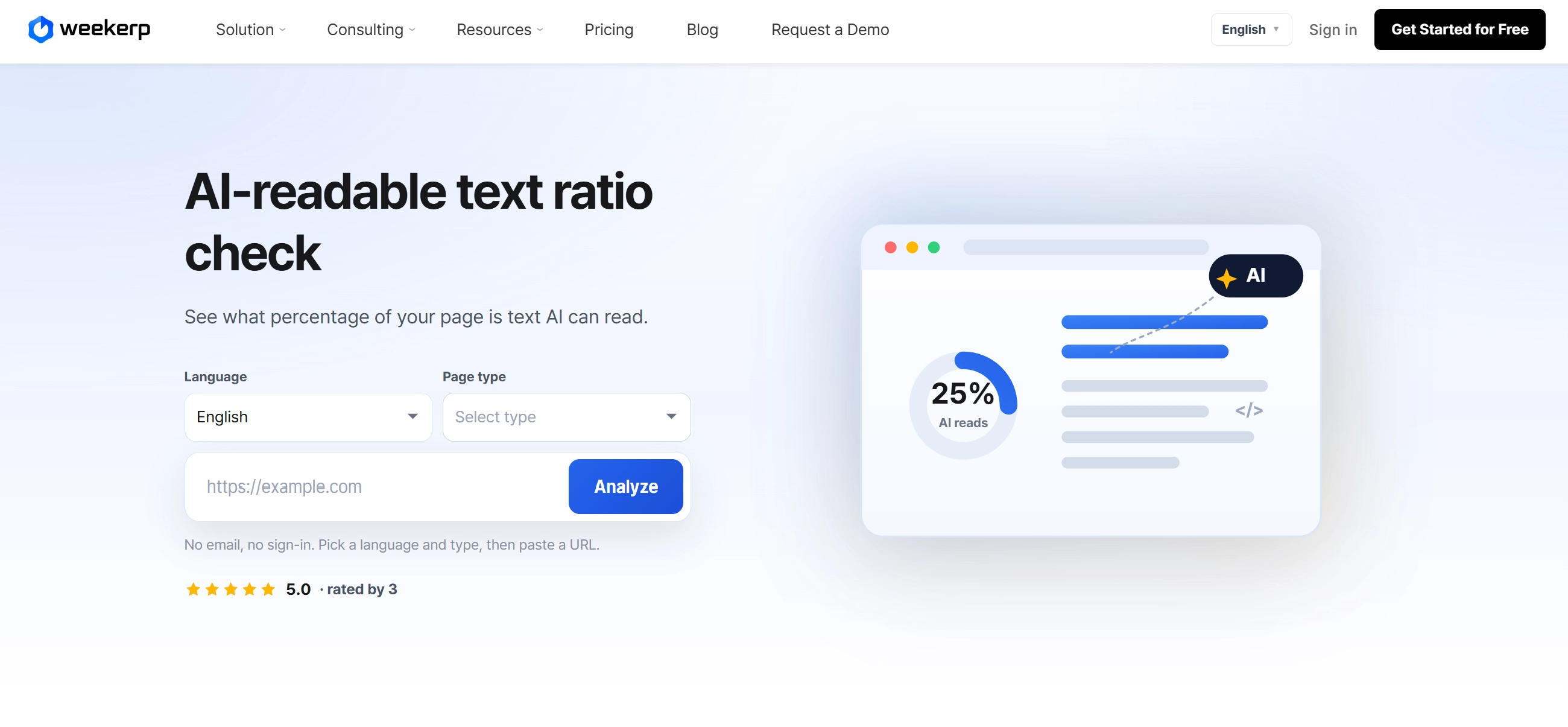
https://weekerp.com/en/resource/text-ratio
We built a free tool at Weekerp so you can check text ratio easily. All you need is your site address (URL), so go check whether your site meets the 0.5% minimum required for AI to read it.
Appendix — Screenshots of cited articles
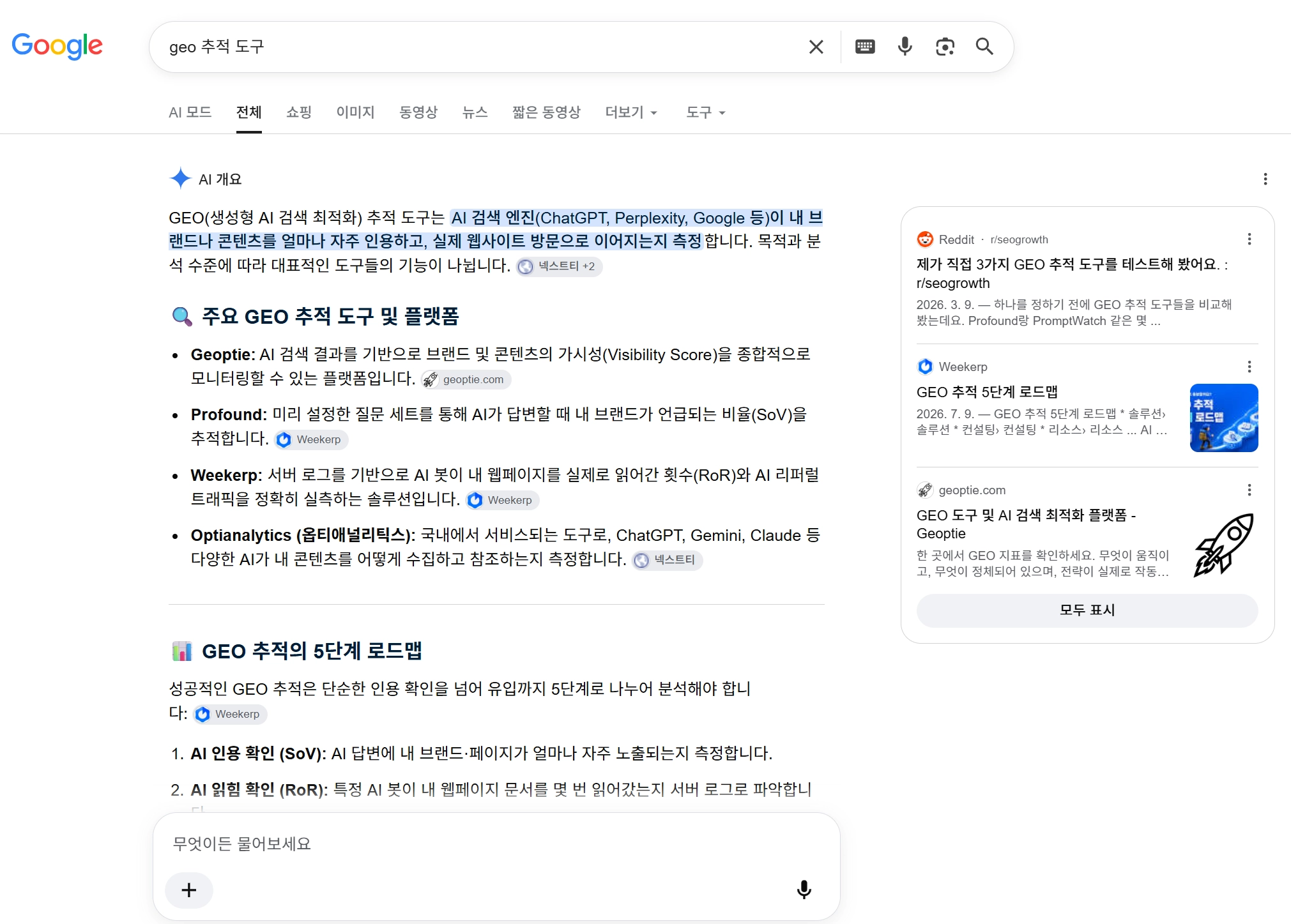
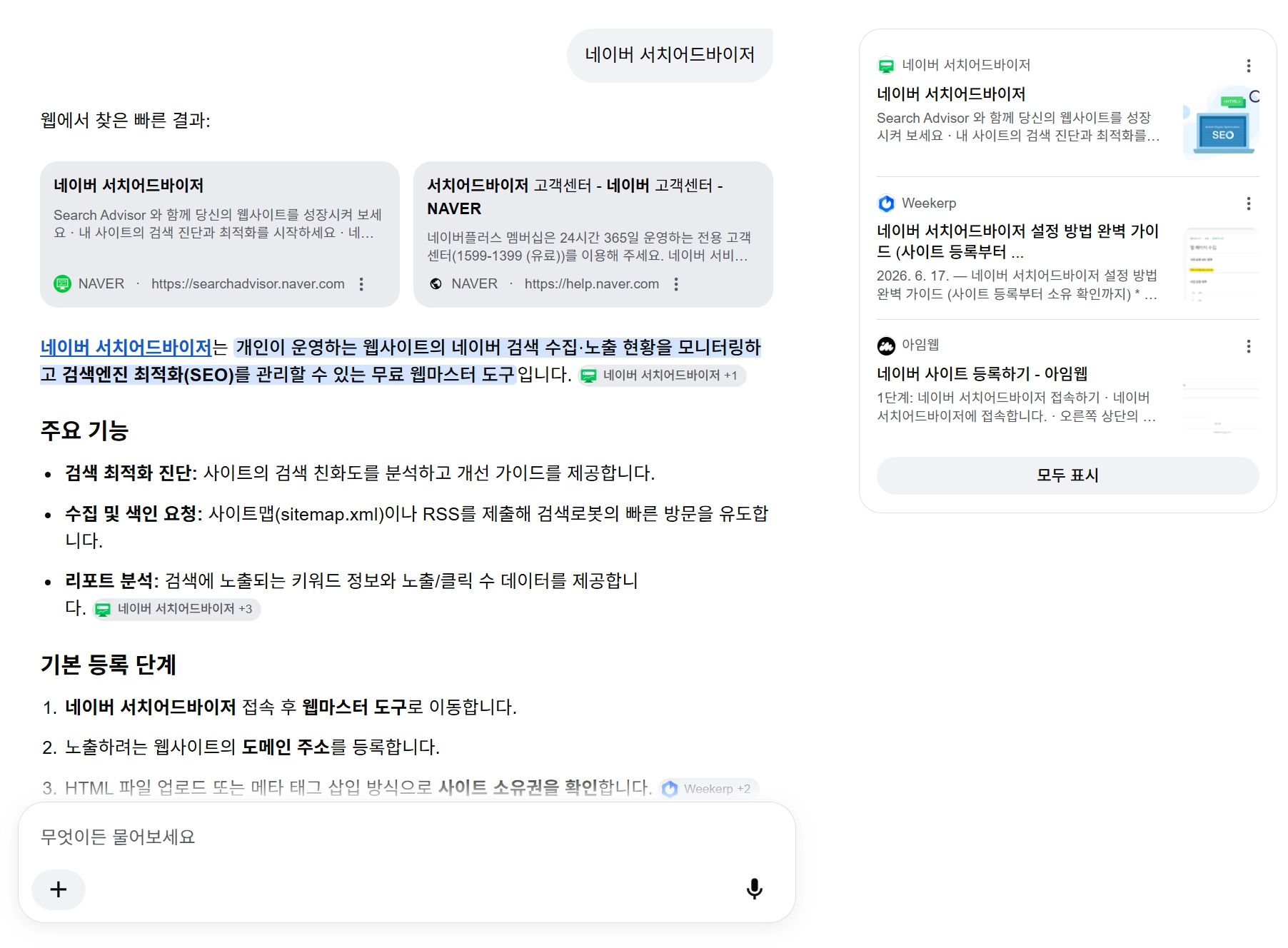
Here are screenshots of articles being cited in AI Overview. They were captured using a VPN and in an incognito tab.
Citation screenshot: "GEO tracking tools" search result
Citation screenshot: "Naver Search Advisor" search result
Frequently asked questions
Q. What's the right text ratio for AI citation?
When we measured Weekerp blog posts that actually get cited well, they came in at 12.8% and 15.6% — roughly the 10–15% range. But this isn't a number to aim for, because raising the ratio doesn't increase citations. The minimum you must clear is 0.5%; beyond that, the content of the body text matters far more than the ratio.
Q. If my text ratio is high, will AI cite me well?
No. There was an article with a solid 14.9% text ratio that still didn't get cited well. It was published on the same site, so its authority and expertise were identical — yet the results diverged, because that article described future plans rather than directly answering the user's question. What separates the cited from the uncited is not the ratio but how clear an answer the body text gives.
Q. What's the problem if my text ratio is below 0.5%?
The page is likely built with a CSR (Client Side Rendering) approach like React or Vue. This approach hands the browser the tools to draw the page rather than a finished page, so from the perspective of an AI that doesn't render the screen, there's no text to read at all. In that case, no matter how good your writing is, AI won't cite you.
Q. Does AI read information inside PDFs or images too?
It can't. Text baked into an image, content held in a separate PDF file, and text attached later by JavaScript are not included in the HTML text. A person can see them, but to AI they don't exist. In this case you don't need to remove the file or the image — just provide the same information once more as HTML text.
Q. How do I check my site's text ratio?
Just enter your site address (URL) into the free Text Ratio Checker Weekerp built. We recommend first checking whether you clear the 0.5% minimum required for AI to read your page.
Enjoyed this article?
Weekerp delivers valuable writing built for GEO. Get the insights first — free, straight to your inbox via our newsletter.