Does llms.txt Work? We Analyzed 68,759 AI Bot Requests
Does llms.txt Actually Work? We Analyzed 68,759 AI Bot Requests Over 4 Weeks
In our previous article, we said we would answer this question with real measurement data rather than speculation. Here are the results after roughly one month of direct observation.
Last June, Weekerp raised three questions in this article to determine whether llms.txt actually works.
- Do AI bots actually read llms.txt?
- Does implementing llms.txt change AI traffic or citations?
- Do AI bots crawl pages listed in llms.txt more frequently?
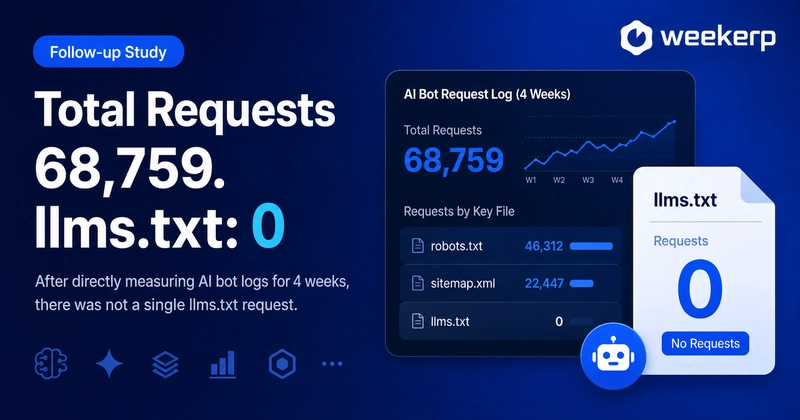
Across two websites, we recorded 68,759 AI bot requests — and 0 requests for llms.txt.
How We Measured It
For this study, we used Weekerp GEO Analytics to measure actual AI bot access.
Traditional web analytics tools usually record a visit only after a user enters the site and an analytics script runs in the browser. AI crawlers such as GPTBot and ClaudeBot, however, do not browse websites the same way humans do or necessarily execute browser-side analytics scripts, which makes it difficult to determine whether they actually fetched a page.
Weekerp GEO Analytics, on the other hand, directly records requests made by AI bots to the website, allowing us to see:
-
which AI bot visited,
-
when it visited,
-
which page it requested,
-
and how many times it was fetched.
We also reviewed individual request logs, not just aggregate crawl counts for GPTBot, OAI-SearchBot, ChatGPT-User, ClaudeBot, Claude-User, PerplexityBot, and other AI bots. For this study, we extracted and compared actual requests to files such as /llms.txt, /robots.txt, and /sitemap.xml.
Key Takeaways
-
Across two production websites, we measured 68,759 AI bot requests over roughly one month, but
/llms.txtreceived 0 requests. -
During the same period,
robots.txtreceived 1,938 requests, whilesitemap.xmlandsitemap.rssreceived 1,224 requests, showing that AI bots do in fact fetch supporting site files. -
Major bots including GPTBot, OAI-SearchBot, ClaudeBot, PerplexityBot, and Applebot never accessed llms.txt.
-
Most requests to llms.txt instead came from website analysis and SEO auditing tools such as Chrome Lighthouse, Semrush, and BuiltWith.
-
Based on the data we observed, creating and maintaining llms.txt is currently a low-priority task for AI search visibility or GEO performance.
-
If your platform generates it automatically, there is little reason to remove it. But we found no evidence that it is worth additional development or maintenance effort.
What We Measured
We measured two live production websites.
| Site | Measurement Period | Site Type | AI Bot Requests |
|---|---|---|---|
| Site A (llms.txt available) | Jul 24 – Aug 16 (24 days) | Healthcare (B2C) | 56,863 |
| Site B (no llms.txt) | Jul 29 – Aug 16 (19 days) | B2B SaaS & Tech Blog | 11,896 |
| Total | 68,759 |
The measurement included major AI and search crawlers such as GPTBot, OAI-SearchBot, and ChatGPT-User, with a total of 82 bots monitored. You can view the full list in Weekerp's managed bot list.
We Excluded Bot-Impersonation Traffic
We initially identify bots using their User-Agent, but User-Agent strings can easily be spoofed by third parties.
To reduce false positives, we cross-validated the User-Agent with the ASN and owning organization of the network from which each request originated.
In other words, the figures in this study are not based on User-Agent strings alone — they also went through network-origin verification.
Question 1. Do AI Bots Read llms.txt?
0 out of 68,759 requests
In this study, we found no case in which an AI bot requested llms.txt.
A total of 68,759 AI bot requests were recorded during the measurement period, yet /llms.txt received 0 requests. GPTBot, OAI-SearchBot, ClaudeBot, PerplexityBot, and Applebot all showed no record of accessing the file.
This was also true for Site A, where /llms.txt had been available and returning HTTP 200 from the beginning of the measurement period.
Question 2. What Happened to the Other Two Questions?
The remaining questions were originally:
- Does implementing llms.txt increase AI traffic or citations?
- Do AI bots crawl URLs listed in llms.txt more frequently?
But the premise itself fell apart.
If the file was never fetched in the first place, it is difficult to argue that it changed AI crawling behavior. Even if URLs listed in llms.txt happened to receive more bot traffic, we would have no basis for attributing that increase to llms.txt.
What If AI Bots Simply Do Not Read These Kinds of Files?
Seeing zero requests to llms.txt raised another question:
What if AI bots generally do not bother reading SEO-related site files?
So we checked requests to /sitemap.xml and /robots.txt during the same period.
The results were very different.
AI Bots Did Read robots.txt and sitemap.xml
| File | AI Bot Requests | Share of Total Requests |
|---|---|---|
| robots.txt | 1,938 | 2.82% |
| sitemap.xml & sitemap.rss | 1,224 | 1.78% |
| llms.txt | 0 | 0.00% |
The result was not that AI bots ignored these types of files altogether. They fetched robots.txt and sitemaps, while leaving llms.txt untouched.
That distinction is the key finding here: AI crawlers do inspect supporting site files, but in this dataset, llms.txt was the one file they consistently did not request.
Different Bots Relied on Different Files
| Bot | robots.txt | sitemap.xml | sitemap.rss | llms.txt |
|---|---|---|---|---|
| Applebot | 317 | 0 | 0 | 0 |
| OAI-SearchBot | 247 | 0 | 0 | 0 |
| ClaudeBot | 178 | 156 | 158 | 0 |
| Bytespider | 99 | 0 | 0 | 0 |
| NaverBot | 70 | 85 | 11 | 0 |
| Bingbot | 26 | 65 | 41 | 0 |
| PerplexityBot | 20 | 0 | 0 | 0 |
| Claude-User | 8 | 0 | 0 | 0 |
| CCBot | 4 | 5 | 1 | 0 |
| GPTBot | 0 | 17 | 17 | 0 |
| Meta-ExternalAgent | 0 | 48 | 7 | 0 |
| ChatGPT-User | 0 | 1 | 0 | 0 |
The sitemap data showed the same pattern.
ClaudeBot requested sitemap.xml 156 times and sitemap.rss 158 times across the two sites, while GPTBot fetched each of them 17 times. Bots that actively discovered and fetched RSS sitemaps still never accessed llms.txt.
On the other hand, Applebot and PerplexityBot did not request a sitemap during the measurement period, but they accessed robots.txt 317 and 20 times respectively.
In other words, AI bots do not all navigate websites in the same way. Different services rely on different supporting files and use different crawling strategies.
| Preference | Bots |
|---|---|
| robots only | Applebot, OAI-SearchBot, Bytespider, PerplexityBot, Claude-User |
| sitemap only | GPTBot, Meta-ExternalAgent |
| Both | ClaudeBot, NaverBot, Bingbot, CCBot |
But llms.txt Still Received 61 Requests
This is where the results became interesting.
Although AI bots never requested /llms.txt, Site A still received 61 requests for the file over the four-week period.
When we examined who was making those requests, most came from SEO and website auditing tools.
| Requester | Requests | Type |
|---|---|---|
| Chrome-Lighthouse | 53 | Web page quality auditing tool |
| TheWebReport | 3 | Website analysis service |
| BuiltWith | 2 | Technology stack detection tool |
| Semrush SiteAuditBot | 1 | SEO auditing tool |
| Domestic ISP traffic | 2 | Presumed direct browser visits |
In other words, the systems requesting llms.txt were not AI bots, but website auditing tools.
Site B makes this even more interesting. It has never had an llms.txt file, so requests to /llms.txt return a 404. Yet similar tools still attempted to access the URL to check whether the file existed.
In this dataset, AI bots did not come looking for llms.txt regardless of whether the file existed, while website analysis tools did.
Our Conclusion So Far
When we wrote the previous article, our position was:
"The benefits are unclear, but the implementation cost is low, so you might as well create one."
After roughly a month of observing actual AI bot traffic, our position has changed.
"We found no value beyond satisfying a checkbox in certain SEO auditing tools."
Across 68,759 AI bot requests, llms.txt received 0 requests. Meanwhile, sitemap.xml and robots.txt continued to be fetched, and the most frequent visitors to llms.txt were not AI systems but website analysis tools such as Lighthouse.
So Weekerp's current position is straightforward:
If llms.txt already exists or is generated automatically, there is no reason to remove it. But we do not currently see a reason to spend additional time and maintenance effort creating llms.txt specifically for GEO.
If AI services begin incorporating llms.txt into their actual discovery and crawling processes in the future, that change should appear in the request logs first. When that happens, we will measure it again and publish the results.
Frequently Asked Questions
Q. Does llms.txt actually work?
Among 68,759 AI bot requests, llms.txt received zero requests. Based on this measurement, we found no evidence that llms.txt affected AI crawling behavior.
Q. Did AI bots really never read llms.txt?
We found no such requests across the two sites measured in this study. The result was the same even on the site where llms.txt existed and returned HTTP 200.
Q. Does that mean AI bots do not read these kinds of files at all?
No. During the same period, major AI bots repeatedly requested sitemap.xml and robots.txt. llms.txt was the exception.
Q. Who is actually reading llms.txt?
In this study, most requests came from website quality and SEO analysis tools such as Chrome Lighthouse, Semrush SiteAuditBot, and BuiltWith.
Q. Should I create an llms.txt file?
If your platform generates one automatically, there is little reason to remove it, and you may choose to create one simply to satisfy checks performed by certain SEO auditing tools.
However, based on this dataset, we found no evidence that justifies spending additional development or maintenance effort on llms.txt for AI search visibility or GEO performance.
Q. Will not having llms.txt hurt GEO performance?
Based on the results of this study, there is no evidence to suggest that it will. None of the major AI bots we measured requested the file at all.
Measurement period: July 24 – August 16, 2026 (varies by site).
Measurement tool: Weekerp GEO Analytics. Results were aggregated from actual AI bot access logs, with suspected bot-impersonation traffic excluded through additional network-origin verification.
Get My Articles by Email
I send emails when I publish content worth reading about SEO, GEO results, and tools developed by Weekerp. Emails are usually sent two or three times a month.