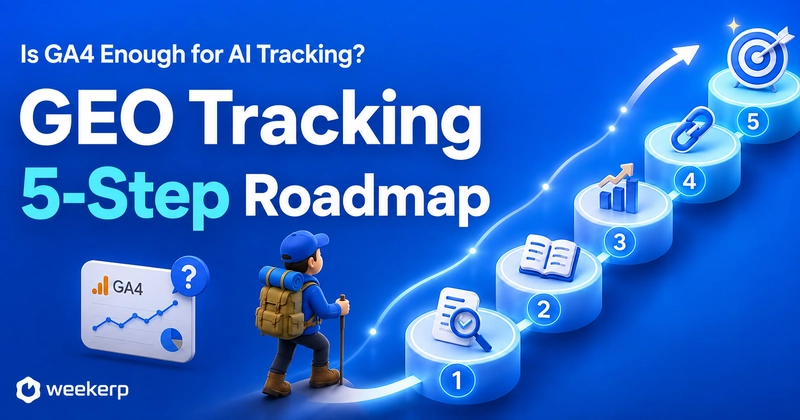
5-Level GEO Analytics Roadmap
How Can You Tell Whether AI Is Citing Your Brand?
A marketer recently asked me this question.
"We already track how often our brand appears in AI responses. Is there a way to prove the results more clearly beyond that?"
Just as GA4 lets you review both traffic and click-through rates, an "answer rate" is not the end of performance measurement. It is only one step.
There are other steps above and below it. Some are easy to measure but less accurate, while others are harder to measure but provide stronger evidence.
This article explains the five stages of the GEO measurement roadmap and proposes a practical framework for tracking GEO performance.
The Five-Level GEO Measurement Roadmap
| Level | Name | Core purpose |
|---|---|---|
| Level 1 | AI citation tracking | Measure how often your brand or pages appear in AI responses |
| Level 2 | AI read tracking | Identify which pages AI systems accessed and read |
| Level 3 | AI visit tracking | Measure visits from users who arrived through AI responses |
| Level 4 | Read-to-click attribution | Connect pages read by AI with actual user visits |
| Level 5 | Intent-to-click attribution | Identify which question intents generated actual clicks |
All AI metrics can be divided into two categories.
1. Estimated numbers
These are values inferred from a sample based on the assumption that actual performance is probably similar.
For example, you might submit several hundred questions to AI services and conclude, "Our brand appeared in 30% of the responses."
This approach is quick and easy to use.
2. Directly measured numbers
These are records of events that actually occurred.
Examples include the exact time an AI bot accessed a page or whether a real person visited your website through an AI service.
This is similar to how Google Analytics measures actual website visitors.
The ultimate purpose of a tracking tool is to gradually replace estimation with direct measurement.
Keep these two categories in mind as you read the rest of the article.
Level 1: AI Citation Tracking
What it does: Checks whether your brand or pages actually appear in AI responses and how often they appear compared with competitors.
The answer rate mentioned by the marketer at the beginning belongs to this level. In marketing, this metric is commonly called SoV, or Share of Voice.
Profound is one of the best-known tracking solutions in this category.
However, this metric remains within the estimated category for two reasons:
- You must define the questions in advance.
- The AI response changes depending on how the question is phrased.
Some critics describe it as "creating your own test, answering it yourself, and then grading your own score."
Example: The percentage of responses that mention your brand for "best summer bedding"
Example: Different brands may appear for similar questions such as "best barbecue sauce for ribs" and "best barbecue sauce for grilling."
-
Type: Estimated metric
-
Metric: SoV, Share of Voice
-
SoV (%) = Responses mentioning your brand / Total queries in the set × 100
-
Competitive SoV (%) = Your mentions / (Your mentions + All competitor mentions) × 100
-
Representative solution: Profound
Level 2: AI Read Tracking
What it does: AI systems cite specific web pages when generating answers. This level tracks how often AI systems access particular pages.
Server-side logs can show:
- Which AI accessed the website
- Which page it accessed
- When and how often it accessed the page
The metric is called PoR, or Rate of Read. Weekerp is a representative solution in this category.
The importance of this level is simple.
A page that AI has never read cannot be cited.
This data cannot be measured by traditional tools such as GA4 or Amplitude, so a separate solution is required.
Example: At 3:00 PM on July 9, ChatGPT accessed the consultation page 921 times
-
Type: Directly measured metric
-
Metric
-
PoR (Pages of Read) - number of pages read (unit: pages)
-
CoR (Coverage of Read) - read coverage (unit: %)
-
RC (Read Count) — valid AI bot requests (unit: requests)
-
-
Formulas
-
PoR = Unique pages accessed at least once by AI bots during the period
-
CoR = PoR / Indexable pages × 100
-
RC = Valid AI bot requests during the period (HTTP 200 and 304 only)`
-
-
Definitions
-
Indexable pages = URLs listed in sitemap.xml (excluding noindex, robots-disallowed, and admin paths)
-
Bot identification = by User-Agent, reported per bot (GPTBot / OAI-SearchBot / PerplexityBot / ClaudeBot, etc.)
-
-
Representative solution: Weekerp
Level 3: AI Visit Tracking
What it does: Identifies people who visited your website after viewing an AI response.
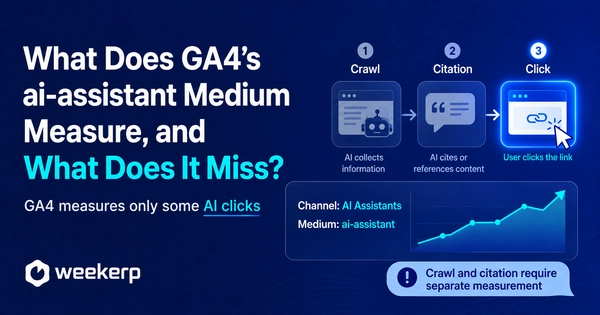
After Level 1, which asks whether your brand appeared, and Level 2, which asks whether your content was read, Level 3 checks whether an actual website visit occurred.
Google Analytics 4 and Weekerp are representative tracking tools for this level.
The problem: This metric is not currently fully accurate.
Referral information is often removed when users arrive through AI services.
As a result, users who actually came from an AI response may be grouped under Direct traffic because the analytics platform cannot identify where they came from.
For this reason, even GA4 cannot measure all AI-originated visits accurately.
Example: GA4 reports 12 visits from ChatGPT, while additional visits with missing attribution are classified as Direct
-
Type: Directly measured, but incomplete
-
Metric: RoV, Rate of AI Visit, commonly referred to as AI referral traffic
-
VC (Visit Count) = AI referral sessions
-
RoV (%) = AI referral sessions / Total sessions × 100
Level 4: Read-to-Click Attribution
What it does: Connects Level 2, where AI reads a page, with Level 3, where a person visits the website.
The goal is to connect these events in one sequence:
"AI read this page, and that exposure led this person to visit our website."
Level 4 represents a more advanced area of measurement.
Levels 1 through 3 are measured separately. Level 4 requires AI reading activity and human visits to be observed along the same path.
This is similar to evaluating website performance by connecting impressions and clicks to calculate conversion rates.
At present, tools that measure AI bot activity and tools that measure human visits generally operate separately.
In addition, Level 3 visit attribution is still incomplete.
However, Level 4 appears achievable in the near future. For example, ChatGPT adds utm_source parameters to some outbound clicks, which makes those visits measurable in GA4.
Weekerp is currently researching and developing this area.
-
Type: Directly measurable once Level 2 can be measured reliably
-
Metric: R2V, Read-to-Visit
-
R2V (%) : Sessions landing on URL u within window T after a bot read of u / Read Count for URL u × 100
-
Representative solution: No standard solution currently exists
Level 5: Intent-to-Click Attribution
What it does: Goes one step further and identifies the question intent that generated an actual click.
Level 4 asks, "Which page generated the visit?"
Level 5 asks, "Which question generated the visit?"
Once the visit is identified, existing analytics tools can continue tracking whether that user eventually converts or purchases.
For example, users asking AI with a "price comparison" intent may visit your website frequently, while users asking with a "how to use it" intent may be directed to competitors.
This level makes it possible to measure traffic by consumer intent and understand user needs more accurately.
Example: Conversion rates are high when a consumer searches around 7:00 PM for tofu to use in doenjang-jjigae for dinner
-
Consumer situation: A family of four preparing dinner and looking for food that children will enjoy
-
Hidden intent, HIC: Wellness, health, child-friendly food, satiety, and dinner-time preparation
-
Product understanding: Looking for healthy tofu for the children's evening meal
-
Value: Enables consumers to be segmented more precisely by intent and characteristics for marketing, distribution, and customer research
At this stage, decisions about which user questions to prepare for and which content to produce can be based on actual data rather than assumptions.
It is an ideal metric for the AI search era.
It goes beyond performance measurement and can influence future content, marketing channels, audience priorities, distribution strategies, and broader management decisions.
The problem: There is currently no practical way to implement this metric fully.
Tracking tools and AI providers would need to work together. In particular, AI providers would need to provide richer attribution data.
One positive development is the introduction of advertising in ChatGPT. This may become an important foundation for making Level 5 possible.
-
Type: Directly measurable once implementation becomes possible
-
Metric: I2V, Intent-to-Visit
-
I2V (%) = Visits attributed to intent group i / Citation impressions for intent group i × 100
-
Representative solution: No standard solution currently exists
Current GEO Tracking Solutions as of July 9, 2026
| Level | Name | Metric | Measurement method | Representative solution | Current status |
|---|---|---|---|---|---|
| L1 | AI citation tracking | SoV | Submit a predefined question set to AI services and measure citations | Profound | Early commercialization |
| L2 | AI read tracking | PoR | Measure AI bot access using server and CDN logs | Weekerp | Early commercialization |
| L3 | AI visit tracking | RoV | Measure AI referral and visitor data | GA4, Weekerp | Partially available but inaccurate |
| L4 | Read-to-click attribution | R2V | Connect AI read logs with user visits | No standard solution | Exploration stage |
| L5 | Intent-to-click attribution | I2V | Connect question intent with actual clicks | No standard solution | Future stage |
Summary
-
GEO tracking is not a single metric. It consists of five levels.
-
Every metric belongs to one of two categories: estimated numbers or directly measured numbers.
-
The commonly used "answer rate" is a Level 1 estimated metric. Some critics describe it as creating your own test and grading your own result.
-
Levels 4 and 5 require a method that connects AI reading activity with actual user visits.
-
Level 2, which directly measures whether AI accessed and read a page, must serve as the foundation for that connection.
Frequently Asked Questions
Q. What is GEO tracking?
GEO tracking measures how often AI search services such as ChatGPT and Perplexity read your content, cite it, and generate actual website visits.
Traditional SEO primarily focused on search rankings. GEO tracking examines how AI systems handle your brand across five stages: citation, reading, visits, attribution, and intent.
Q. Is the answer rate, or SoV, enough to measure performance?
No. The answer rate is only Level 1 of the five-level framework and belongs to the estimated category.
It works by submitting a predefined set of questions to AI services and counting how often your brand appears.
This is useful, but it is similar to creating your own test and calculating your own score.
To demonstrate actual performance, you also need to know whether AI systems truly accessed your pages at Level 2 and whether those interactions led to visits at Level 3 or above.
Q. Why can GA4 not show whether AI bots read our pages?
Tools such as GA4 and Amplitude depend on scripts embedded in a website.
AI bots generally do not execute those scripts, so their visits are excluded from script-based analytics.
AI bot access must instead be measured directly through server logs. This is why Level 2 requires a separate tracking solution.
Q. Why is AI-originated traffic, or RoV, inaccurate in GA4?
Referral information is often removed when users visit a website through an AI response.
As a result, visits that actually came from AI services may be grouped under Direct traffic.
This causes GA4 to report fewer AI visits than actually occurred, which is why Level 3 is considered directly measured but incomplete.
Q. What is the difference between Level 4, R2V, and Level 5, I2V?
Both levels connect AI reading activity with user visits, but they use different attribution criteria.
Level 4 identifies which page generated a visit.
Level 5 identifies which question intent generated the visit.
Level 4 may become practical in the near future because ChatGPT passes utm_source parameters for some clicks, making them measurable in GA4.
Level 5 remains a future-stage concept because it requires AI providers to share richer information about the user's original question and intent.
Get My Articles by Email
I send emails when I publish content worth reading about SEO, GEO results, and tools developed by Weekerp. Emails are usually sent two or three times a month.